
The Belt of Camellias Wrapped Around the Back of Seonunsa Temple
Place · Seonunsa Temple, Samin-ri, Asan-myeon, Gochang-gun, Jeollabuk-do
Visit this tree
Japanese Camellia Forest of Seonunsa Temple, Gochang
At a glance
- Tree
- Camellia Forest of Seonunsa Temple, Gochang
- Age · era
- Designated a Natural Monument in 1967
Story
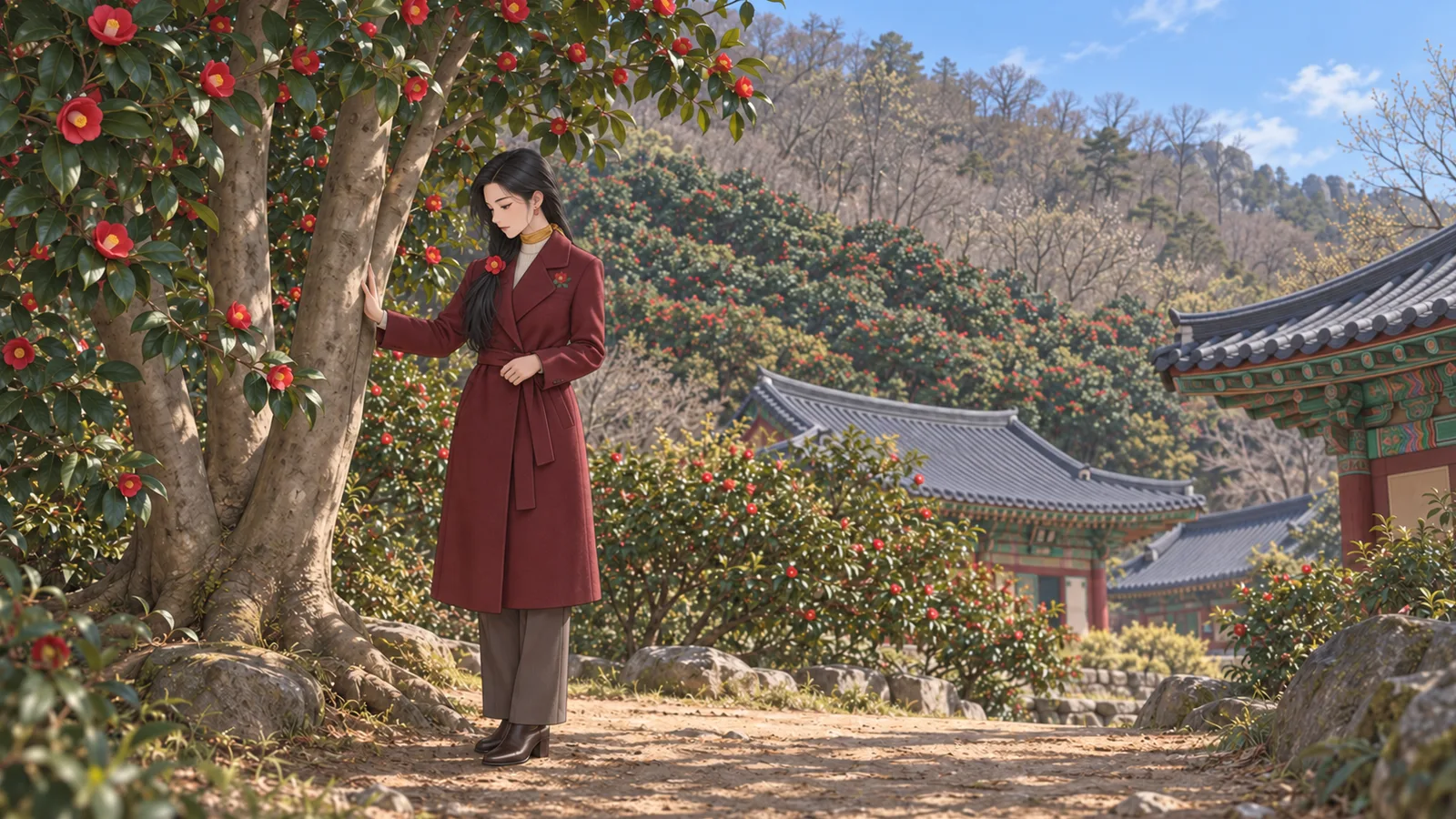
The Camellia Forest of Seonunsa Temple in Gochang was designated a Natural Monument in 1967 (area 35,596 sq. m, owned by Seonunsa Temple of the Jogye Order of Korean Buddhism, managed by Gochang-gun). The Korea Heritage Service explains that camellias are called chunbaek (spring camellia), chubaek (autumn camellia) or dongbaek (winter camellia) depending on when they bloom, and that this forest was made after Seonunsa Temple was founded in the 24th year of King Wideok of Baekje (577), forming a thin belt 30 m wide below the sloping mountain behind the temple. The Encyclopedia of Korean Culture writes that when it was planted is unknown but it is thought to have been planted after the founding of Seonunsa, and records that the trees average around 6 m tall, with the largest reaching 80 cm in trunk diameter at the root collar. Although camellias grow in many places in the southern region, it is rare for them to remain as a single beautiful forest like this (Encyclopedia), and the Korea Heritage Service gives as reasons for designation its cultural value as a temple forest and the value of conserving an old camellia forest.
Sources — 4 records and legends
Records are facts written in the sources. Legends are stories handed down over time. Sources are in Korean.
Record
- From the Encyclopedia of Korean Culture: the Camellia Forest of Seonunsa Temple in Gochang was designated a Natural Monument on 11 February 1967 (area 35,596 sq. m). It is a forest continuing in a belt about 30 m wide on the slope behind Seonunsa Temple, with trees averaging around 6 m tall. When it was planted is unknown, but it is thought to have been planted after the founding of Seonunsa, and although camellias grow in many places in the southern region, it is rare for them to remain as a single beautiful forest like this.
한국민족문화대백과사전 · checked 2026-09-30
- The Encyclopedia of Korean Culture records that this forest was designated a Natural Monument on 11 February 1967, is a camellia forest continuing about 30 m wide, with trees averaging around 6 m tall and the large ones about 80 cm in trunk diameter at the root collar and about 30 cm at chest height, and that although camellias grow in many places in the southern region, it is rare for them to remain as a single beautiful forest like this.
한국민족문화대백과사전 '고창 선운사 동백나무 숲' · checked 2026-10-04
- The Korea Heritage Portal classifies the Camellia Forest of Seonunsa Temple in Gochang as a Natural Monument (cultural and historical monument / religious), and lists area 35,596 sq. m, designation date 17 February 1967, location San 68, Samin-ri, Asan-myeon, Gochang-gun, Jeollabuk-do, owner Seonunsa Temple of the Jogye Order of Korean Buddhism, and managing body Gochang-gun.
국가유산청 국가유산포털 '고창 선운사 동백나무 숲' 기본 정보 · checked 2026-10-04
- The Korea Heritage Service explains that camellias are called chunbaek, chubaek or dongbaek depending on when they bloom, that the Samin-ri Camellia Forest in Gochang was made after Seonunsa Temple was founded in the 24th year of King Wideok of Baekje (577) and forms a thin belt 30 m wide below the sloping mountain behind the temple, and that it was designated a Natural Monument for its high cultural value as a temple forest and its value for conserving an old forest.
국가유산청 국가유산 공개 API 상세(천연기념물 '고창 선운사 동백나무 숲', 지정 1967-02-17) · checked 2026-10-04
Spot a mistake?Tell usRead in Korean