
The Fringe Tree of Cheongok-ri, Whose Blossoms Foretold the Year's Harvest
Place · Cheongok-ri, Juchon-myeon, Gimhae-si, Gyeongsangnam-do (50 Seobu-ro 1638beon-gil)
Visit this tree
Chinese Fringetree of Cheongok-ri, Gimhae
At a glance
- Tree
- Fringe Tree of Cheongok-ri, Gimhae
- Age · era
- Designated a Natural Monument in 1982
Story
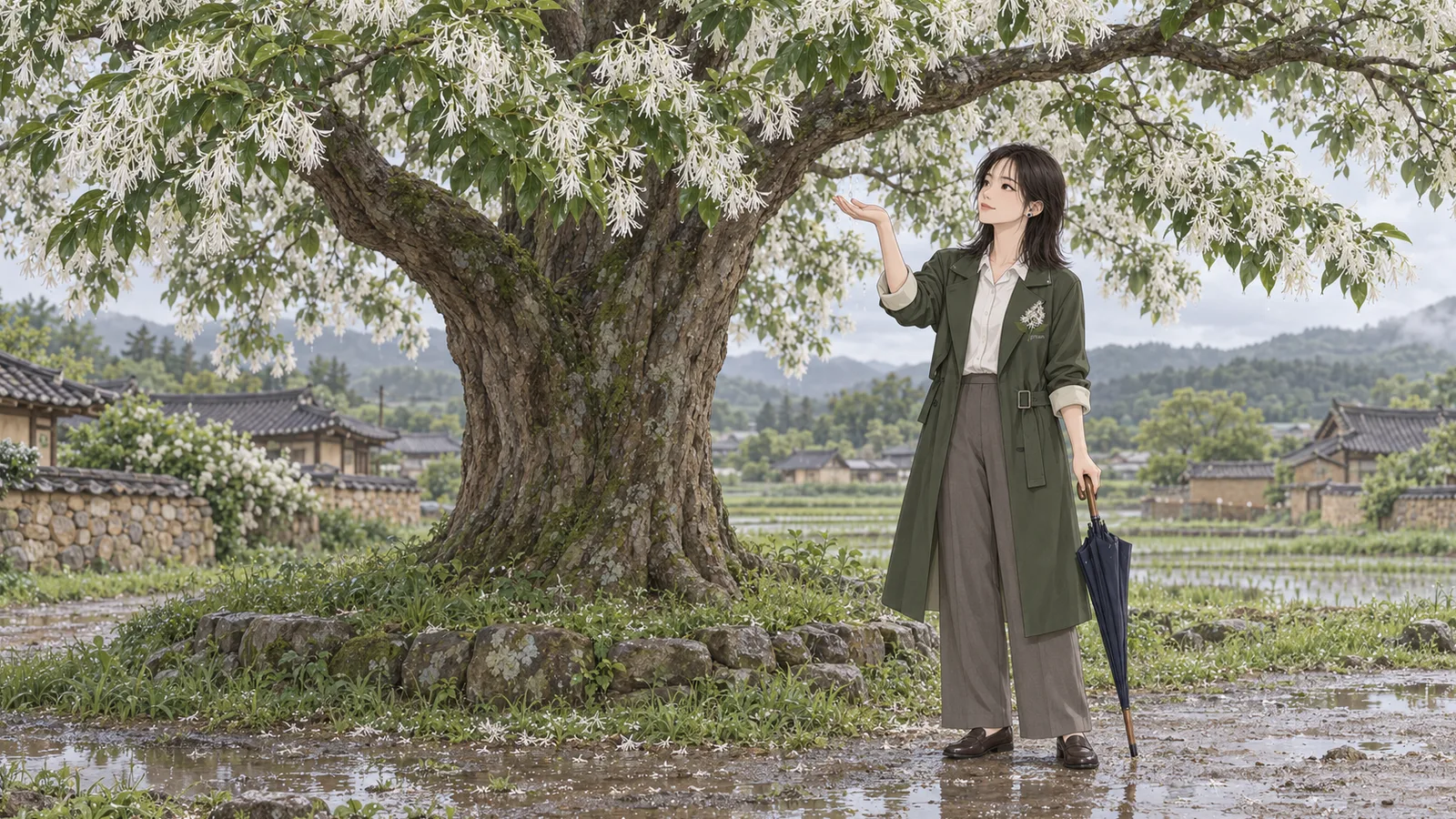
Gimhae-si introduces the Natural Monument "Fringe Tree of Cheongok-ri, Gimhae" (designated 9 November 1982, Juchon-myeon) as a sacred tree (sinmok) that has long protected Cheongok-ri, and says a village rite (dongje) is held around May, when the fringe tree is in full bloom. It is known as a tree that foretells the year's farming: if the fringe tree blooms heavily that year there will be a good harvest, and if it blooms sparsely there will be a bad one. A story is handed down in the village that if the east branches bloom heavily the east plain will have a good harvest, and if the west branches bloom heavily the west plain will. The Korea Heritage Service records the tree's age as about 500 years (estimated) and its height as 13.0 m, and considers that because the village has many prehistoric remains such as fortresses, dolmens and shell middens, the tree has been preserved along with the relics. It also interprets that because the fringe tree grows well where there is plenty of water and blooms fully when rainfall is moderate, the legend arose from long observation of nature. The Encyclopedia of Korean Culture introduces, as one theory of the name's origin, that when the flowers bloom in profusion the rice crop does well and people get to eat rice, so the tree came to be called ipap (ibap, that is, cooked rice), and records that in Jeollanam-do it is called ipha-namu (the "beginning of summer tree") because it blooms around Ipha (the start of summer), and it is said that if the flowers bloom fully all at once when the rice seedbed is started it will be a good harvest, if they hardly bloom a bad one, and if they bloom listlessly a severe drought.
Sources — 4 records and legends
Records are facts written in the sources. Legends are stories handed down over time. Sources are in Korean.
Record
- The Korea Heritage Service explains that the Fringe Tree of Cheongok-ri, Gimhae is estimated to be about 500 years old and 13.0 m tall, that Cheongok-ri has many prehistoric remains such as fortresses, dolmens and shell middens, so the tree is considered to have been preserved along with other relics, and that because the fringe tree grows well where there is plenty of water and blooms fully when rainfall is moderate, the harvest-foretelling legend is seen as having arisen from long observation of nature.
국가유산청 국가유산 공개 API 상세(천연기념물 '김해 천곡리 이팝나무', 지정 1982-11-09) · checked 2026-10-04
Legend
- From the Gimhae City Hall introduction of Natural Monuments: Gimhae-si introduces the Natural Monument "Fringe Tree of Cheongok-ri, Gimhae" (designated 9 November 1982) as a tree known for foretelling the year's farming, because if it blooms heavily that year there will be a good harvest and if it blooms sparsely a bad one. It also passes on the tradition that if the east branches bloom heavily the east plain will have a good harvest and if the west branches bloom heavily the west plain will.
김해시청 천연기념물 소개 · checked 2026-09-30
- Gimhae-si introduces the Fringe Tree of Cheongok-ri, Gimhae, designated on 9 November 1982, as a sacred tree that has long protected Cheongok-ri, with a village rite held around May when the flowers are in full bloom, and says a story is handed down in the village that if the east branches bloom heavily the east plain will have a good harvest and if the west branches bloom heavily the west plain will.
김해시청 문화유산 소개 '김해 천곡리 이팝나무' · checked 2026-10-04
- The Encyclopedia of Korean Culture gives, as one theory of the name's origin, that when the flowers bloom in profusion the rice crop does well and people get to eat rice, so the tree came to be called ipap (ibap), and records that in Jeollanam-do it is called ipha-namu because it blooms around Ipha (the start of summer), and that it is said that if the flowers bloom fully all at once when the seedbed is started it will be a good harvest, if they hardly bloom a bad one, and if they bloom listlessly a severe drought.
한국민족문화대백과사전 '이팝나무' · checked 2026-10-04
Spot a mistake?Tell usRead in Korean