
Dried Persimmons Scarier Than a Tiger: The 530-Year-Old "First Persimmon Tree Under Heaven" and Sangju Dried Persimmons
Place · Oenam-myeon, Sangju-si, Gyeongsangbuk-do ("The First Persimmon Tree Under Heaven")
Visit this tree
The First Persimmon Tree Under Heaven, Sangju
At a glance
- Tree
- The First Persimmon Tree Under Heaven, Sangju
- Age · era
- Joseon (tribute records of 1454 and 1468), Japanese colonial period (the folktale took hold), National Agricultural Heritage in 2019
Story
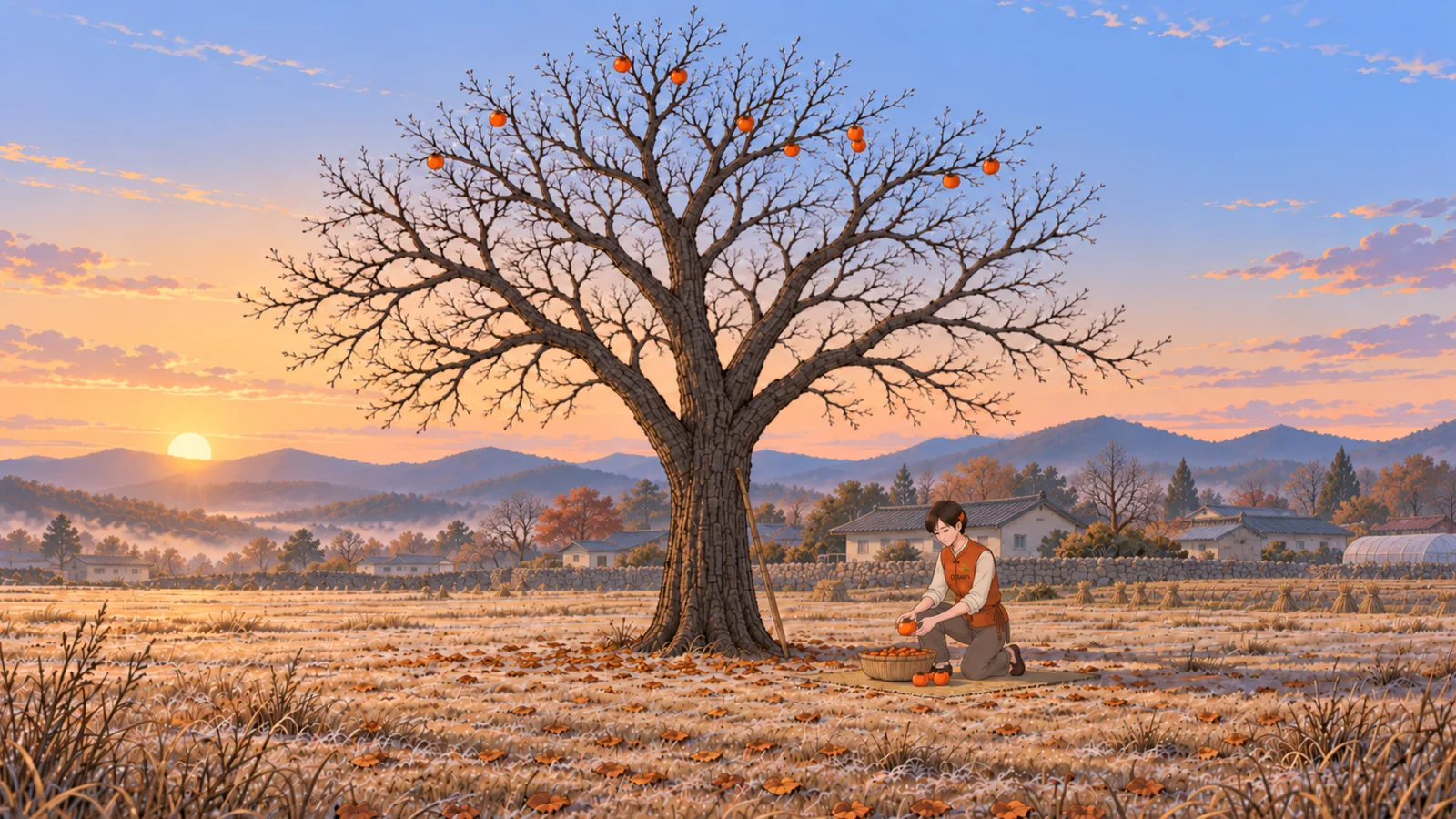
According to the Encyclopedia of Korean Culture, "The Tiger and the Dried Persimmon" (Horangi-wa Gotgam) is a folktale in which a foolish tiger mistakes a dried persimmon for something scarier than itself and runs away; it is found across the country and took hold as a traditional children's tale when it was included in textbooks and in collections such as the Joseon Dongwajip around the Japanese colonial period. In the story, a tiger overhears a child who keeps crying when told "the tiger is coming" but stops crying when told "look, a dried persimmon"; when a cow thief climbs onto his back, the tiger takes him for the dried persimmon and runs for his life. Sangju, the home of dried persimmons, is known as the "land of three whites" (samback): white rice, silkworms and persimmons dusted with white sugar bloom. The Sejong Sillok Jiriji (1454) lists soft persimmons (hongsi) and dried persimmons (gotgam) in the tribute section for Gyeongsang-do, and the Yejong Sillok (1468) records that "the tribute of dried persimmons was allotted to Sangju". The 530-year-old "First Persimmon Tree Under Heaven" in Oenam-myeon, Sangju, is the symbol of Sangju dried persimmons and a heritage showing the history of grafting technique. According to Sangju-si, this tree in Soeun-ri, Oenam-myeon was said among residents to be 750 years old, but a 2009 age appraisal by the National Institute of Forest Science confirmed it as 530 years; its leaves match persimmon DNA and its roots match Korean date-plum (goyomnamu) DNA, showing it to be the oldest grafted tree in Korea, and it still yields more than 5,000 dried persimmons every year. In 2019, "Sangju Traditional Dried Persimmon Farming" was designated National Agricultural Heritage No. 15. The name gotgam seems to come from persimmons skewered on a bush-clover (ssari) skewer (kkotchi) and dried. And the few persimmons left unpicked at harvest are listed in the Standard Korean Language Dictionary under the name "kkachibap" (magpie food).
Sources — 4 records and legends
Records are facts written in the sources. Legends are stories handed down over time. Sources are in Korean.
Record
- The Encyclopedia of Korean Culture records that Sangju is famous as the "land of three whites": white rice, silkworms and persimmons dusted with white sugar bloom; that the Sejong Sillok Jiriji (1454) lists soft persimmons and dried persimmons in the tribute section for Gyeongsang-do and the Yejong Sillok (1468) records that the tribute of dried persimmons was allotted to Sangju; that "Sangju Traditional Dried Persimmon Farming" was designated National Agricultural Heritage No. 15 in 2019; that the origin of the word gotgam seems to be persimmons skewered on a bush-clover skewer and dried; and that the 530-year-old "First Persimmon Tree Under Heaven" in Oenam-myeon is the symbol of Sangju dried persimmons and a heritage showing the history of grafting technique.
한국민족문화대백과사전 '상주곶감' (집필 2022 조연남 상주시립박물관 학예사, 최종수정 2023-10-10) · checked 2026-10-04
- Sangju-si explains that the "First Persimmon Tree Under Heaven" in Soeun-ri, Oenam-myeon still bears fruit every autumn and yields more than 5,000 dried persimmons a year, and that residents had said it was 750 years old but a 2009 age appraisal by the National Institute of Forest Science fixed it at 530 years, confirming it as the oldest grafted tree in Korea. It writes that persimmon trees are propagated by grafting branches onto Korean date-plum trees to maintain quality, and that this tree's leaf DNA matches that of other persimmon leaves and its root DNA matches Korean date-plum leaves, so the record for the oldest grafted tree moved from an 81-year-old apple tree in Pyeonggwang-dong, Daegu, to this tree.
상주시 상주곶감농업유산 누리집 '최고령 감나무 — 하늘아래 첫 감나무' · checked 2026-10-14
Legend
- From the Standard Korean Language Dictionary of the National Institute of Korean Language: the dictionary defines "kkachibap" (magpie food) as "persimmons left unpicked, a few at a time, for birds such as magpies to eat".
국립국어원 표준국어대사전 · checked 2026-09-30
- The Encyclopedia of Korean Culture explains that "The Tiger and the Dried Persimmon", also told across the country as "The Dried Persimmon Scarier Than a Tiger" and the like, is a folktale in which a foolish tiger mistakes a dried persimmon for something scarier than itself and runs away, that it took hold as a traditional children's tale when it was included in textbooks and in collections such as the Joseon Dongwajip around the Japanese colonial period, and that the plot has a tiger overhearing a child stop crying at the words "look, a dried persimmon" and running away, mistaking a cow thief who climbed on his back for the dried persimmon.
한국민족문화대백과사전 '호랑이와 곶감' (집필 1995 최인학, 최종수정 2023-07-15) · checked 2026-10-04
Spot a mistake?Tell usRead in Korean