
Samgoejeong, the Pavilion of Three Zelkovas: The Oga-ri Village Guardian Trees That Watched Over a Village for 800 Years
Place · 321 Oga-ri, Jangyeon-myeon, Goesan-gun, Chungcheongbuk-do (at the entrance to Uryeong Village)
Visit this tree
Japanese Zelkova of Oga-ri, Goesan
At a glance
- Tree
- Zelkova Trees of Oga-ri, Goesan
- Age · era
- Village founded about 800 years ago (per the column), designated a Natural Monument in 1996, column written in 2011 (the protected area was tidied about 5 years earlier)
Story
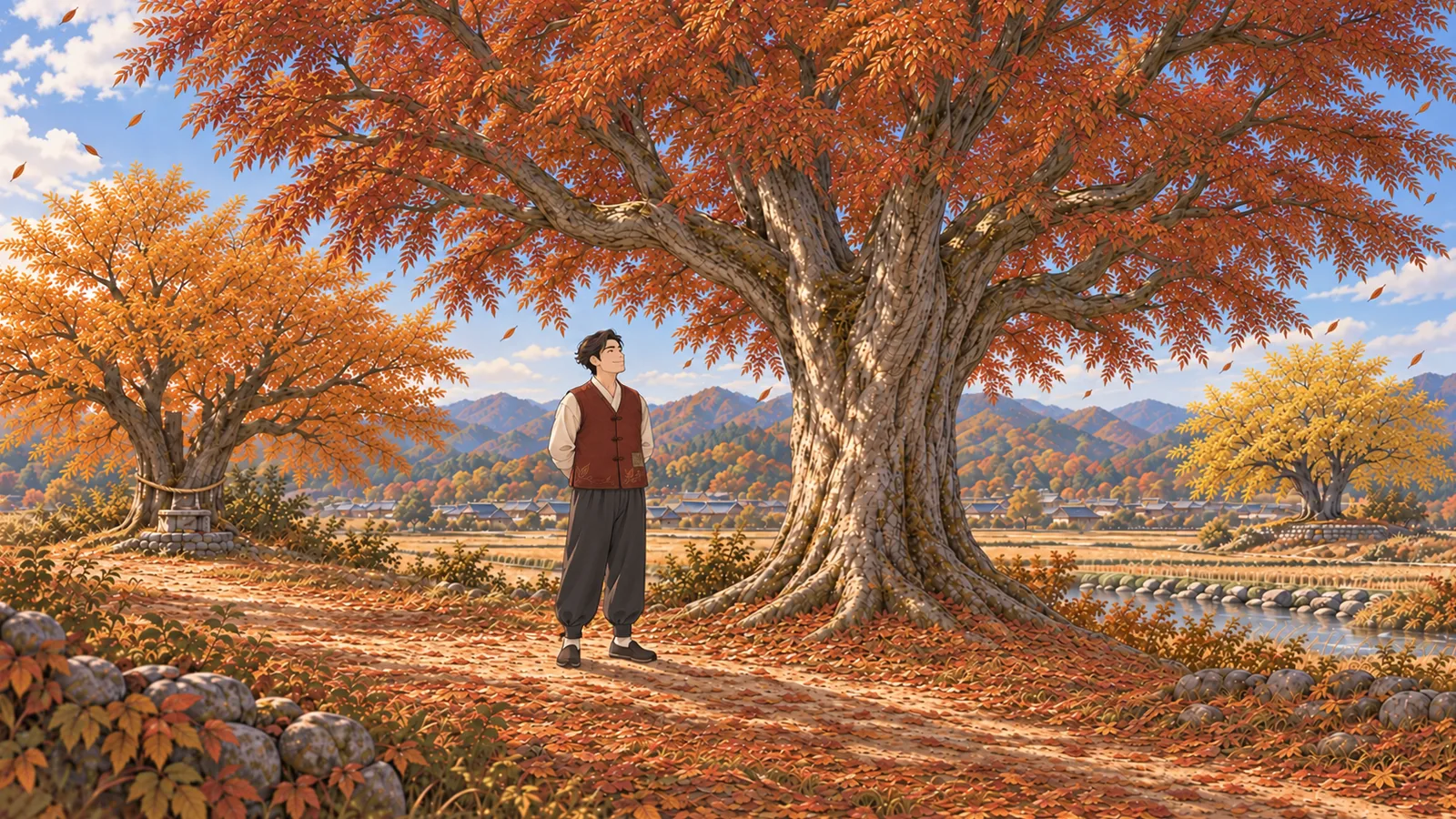
At the entrance of Uryeong Village in Oga-ri, Jangyeon-myeon, Goesan-gun, Chungcheongbuk-do, stand three zelkova trees that villagers call Samgoejeong (三槐亭), meaning the "pavilion of three zelkovas". A column by Ko Gyu-hong in the Seoul Shinmun (2011) writes that Uryeong Village was founded on this spot 800 years ago and that the people who founded it planted trees along the stream. It says the three trees stand one at each corner of a large triangle at the village entrance, that the lowest one (Hagoemok) and the middle one (Sanggoemok) were designated together as Natural Monuments, and that the remaining one, on slightly higher ground, was left out because of its smaller size. The Korea Heritage Service portal records the designation date as 30 December 1996, estimates the age at about 800 years as of designation, and explains that there is no pavilion, but the three trees look like one, so they are called Samgoejeong. The reason for designation is the folkloric and biological value of trees that have lived "in the care and attention of their ancestors". For a long time the village held its dangsan rite at Hagoemok. As of the column, Hagoemok is 19 m tall and 9.4 m around at chest height; its trunk splits in three at about 2 m high, and the thickest trunk broke off long ago and was repaired. In front of the Hagoemok trunk is a stone altar, and a sacred rope (geumjul) is strung around it. One resident said that the dangsan rite is held on the evening before the first full moon of the lunar new year, and that because it is a Natural Monument the state helps with the offering food and ritual supplies. The Korea Heritage Service portal and the Korea Tourism Organization introduce a seonghwangje rite (spelled "seonangje" on the signboard) held every year on the first full moon under Hagoemok. The column judges Sanggoemok (25 m tall and 8 m around as of the column), with its typical zelkova form and branches spread evenly in all directions, to be fit to be named the most beautiful of all zelkovas in Korea. An old woman of the village in the column says that although there is no particular story attached to the tree, it is a village tree everyone in the village is proud of. About five years before the column was written, the sloping fields around it were turned into a protected area, with a parking lot, a simple toilet and a small pavilion near the trees. The column writes that even among zelkovas, the autumn color differs a little from tree to tree.
Sources — 7 records and legends
Records are facts written in the sources. Legends are stories handed down over time. Sources are in Korean.
Record
- The Ko Gyu-hong column writes that Uryeong Village was founded 800 years ago and the founders planted trees along the stream, that residents call the three trees Samgoejeong, meaning the "pavilion of three zelkovas", and that of these, Hagoemok and Sanggoemok were designated Natural Monuments. It judges Sanggoemok to be fit to be named the most beautiful of all zelkovas in Korea.
서울신문 [고규홍의 나무와 사람이야기] (51) 괴산 오가리 느티나무 (2011-10-27, 고규홍 나무칼럼니스트) · checked 2026-10-04
- The Korea Heritage Service portal records the designation date of the Oga-ri zelkovas of Goesan as 30 December 1996 and the location as 321 Oga-ri, Jangyeon-myeon, plus one other lot, estimates the age at about 800 years as of designation, and explains that villagers hold a seonghwangje rite (spelled "seonangje" on the signboard) every year on the first full moon under Hagoemok, that the three trees look like a pavilion and so are called Samgoejeong, and that they were designated as Natural Monuments for their high folkloric and biological value.
국가유산청 국가유산포털 — 천연기념물 괴산 오가리 느티나무 (기본정보·국가유산 설명·개별안내판 설명) · checked 2026-10-04
- The Ko Gyu-hong column (2011) writes that the three trees stand one at each corner of a large triangle at the entrance of Uryeong Village and that in autumn 2011 each was tinted a different color. It says the village has about thirty households, that the remaining tree, on slightly higher ground than Hagoemok and Sanggoemok, was left out of the Natural Monument designation because of its smaller size, and that about five years before the column was written the sloping fields around were turned into a protected area, with a parking lot, a simple toilet and a small pavilion near the trees.
서울신문 [고규홍의 나무와 사람이야기] (51) 괴산 오가리 느티나무 (2011-10-27, 고규홍 나무칼럼니스트) · checked 2026-10-08
- The Ko Gyu-hong column (2011) writes that Hagoemok is 19 m tall and 9.4 m around at chest height, with a trunk that splits in three at about 2 m high, the thickest of which broke off long ago and was repaired. It writes that Sanggoemok has the typical form of a zelkova, 25 m tall and 8 m around at chest height, with branches spread evenly in all directions.
서울신문 [고규홍의 나무와 사람이야기] (51) 괴산 오가리 느티나무 (2011-10-27, 고규홍 나무칼럼니스트) · checked 2026-10-08
Legend
- From the Korea Tourism Organization's Korea Travel Guide: in Oga-ri, Jangyeon-myeon, Goesan-gun, Chungcheongbuk-do, there are trees called Sanggoemok and Hagoemok, and the Korea Tourism Organization introduces that villagers hold a seonghwangje rite every year on the first full moon under Hagoemok (basic information confirmed on the Korea Heritage Service portal). The reason for designation is recorded as 'a large old tree that has lived through a long time in the care and attention of its ancestors, with high value as folkloric and biological material.' The custom of villagers holding the seonghwangje rite every year on the first full moon under Hagoemok, which continues today, is introduced as folk tradition.
한국관광공사 대한민국 구석구석 · checked 2026-09-30
- A resident in the column says the dangsan rite is held on the evening before the first full moon and that, because it is a Natural Monument, the state helps with the food and supplies. The column writes that villagers have long held the dangsan rite at Hagoemok, with a stone altar in front of the trunk and a sacred rope on the trunk.
서울신문 [고규홍의 나무와 사람이야기] (51) 괴산 오가리 느티나무 (2011-10-27, 고규홍 나무칼럼니스트) · checked 2026-10-04
- An old woman of the village in the Ko Gyu-hong column (2011) says that although there is no particular story attached to the tree, it is a village tree everyone in the village is proud of. The columnist speculates that the zelkova was a landmark pointing out the village, a pavilion of shade in summer, and perhaps also thought able to ward off evil spirits, and writes that the autumn color of zelkovas differs a little from tree to tree.
서울신문 [고규홍의 나무와 사람이야기] (51) 괴산 오가리 느티나무 (2011-10-27, 고규홍 나무칼럼니스트) · checked 2026-10-08
Spot a mistake?Tell usRead in Korean