
The Pine That Lifted Its Branch for the King: Jeongipumsong, 600 Years of Wounds and Its Heirs
Place · Songnisan-myeon, Boeun-gun, Chungcheongbuk-do (at the entrance to Beopjusa Temple)
Visit this tree
Jeongipumsong, Japanese Red Pine of Songni, Boeun
At a glance
- Tree
- Jeongipumsong (Pine of the Senior Second Rank)
- Age · era
- 1464 (date according to legend)
Story
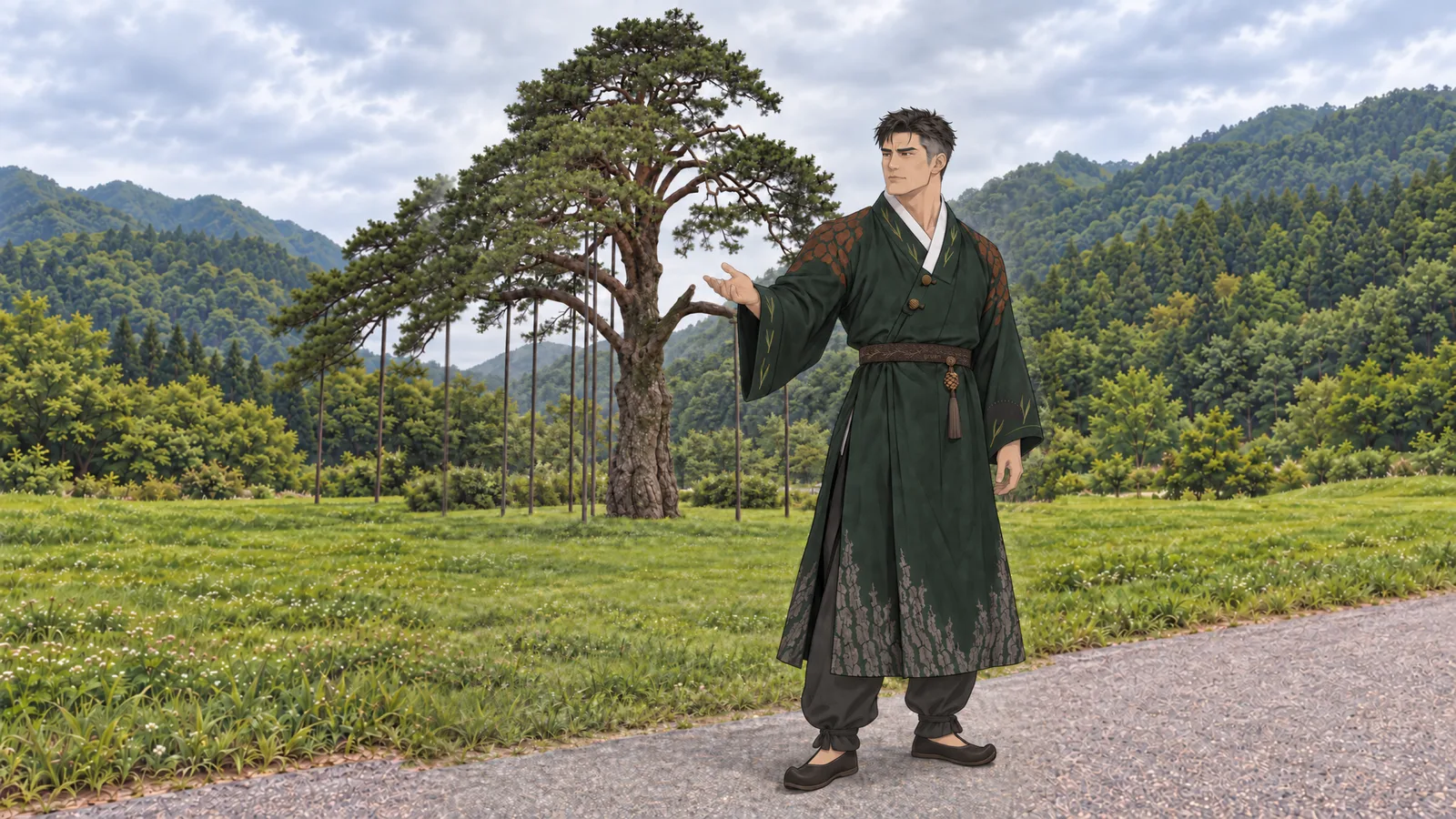
Standing in the middle of the road to Beopjusa Temple on Songnisan, Jeongipumsong is a pine estimated to be about 600 years old (per the Korea Heritage Service: 17.0 m tall, 4.9 m in circumference at chest height, designated a Natural Monument in 1962). The Korea Heritage Service's commentary tells that in 1464, the 10th year of King Sejo, on his visit to Beopjusa the royal palanquin caught on a drooping branch; Sejo said, "The palanquin is catching," and the pine lifted its branch to clear the way. It also tells that he sheltered from the rain under the tree, and says Sejo honored its loyalty with the rank of jeongipum (senior second rank, equivalent to today's minister level). The tree was originally shaped like an open straw hat or umbrella, but in the early 1980s a large protective net was placed over it because of pine needle gall midge damage, and in 1993 a strong wind broke a large western branch, badly spoiling its shape. It later lost branches again in gusts in 2007 and 2010 and in Typhoon Bolaven in 2012, and in 2014 supports for its large branches were installed (JoongAng Ilbo, 2021). A pine in Seowon-ri, south of Songnisan (a Natural Monument since 1988), is known as Jeongburinsong (the Lady Pine); a comparison likened the upright single trunk of Jeongipumsong to the masculine and its own umbrella-like spread to the feminine. Attempts were made in 2002 and 2003 to pollinate it with Jeongipumsong pollen to raise successor trees. In 2001 the National Institute of Forest Science held a wedding ceremony with Jeongipumsong as the father and produced its eldest successor tree, and from 2020 Boeun-gun, with Korea Heritage Service approval, distributed 340 successor trees (2024 report). In 2024 the National Institute of Forest Science decoded a standard pine genome using Jeongipumsong.
Sources — 10 records and legends
Records are facts written in the sources. Legends are stories handed down over time. Sources are in Korean.
Record
- The Korea Heritage Service portal lists the Jeongipumsong of Songni, Boeun as a Natural Monument and records its designation date, 7 December 1962, and its location.
국가유산포털(국가유산청) — 보은 속리 정이품송 · checked 2026-10-01
- The Korea Heritage Service's commentary says Jeongipumsong stands in the middle of the road to Beopjusa Temple and is estimated to be about 600 years old, 17.0 m tall, with a circumference of 4.9 m at chest height. In the early 1980s a large protective net was put up because of pine needle gall midge damage. It was originally shaped like an open straw hat or umbrella, but a strong wind in 1993 broke a large western branch and badly spoiled its shape.
국가유산청 국가유산 정보 OpenAPI — 보은 속리 정이품송 해설 · checked 2026-10-06
- The Korea Heritage Service's commentary records that the Seowon-ri pine stands beside the road in Seowon-ri, south of Songnisan, is estimated to be about 600 years old, and that in 2002 and 2003 an attempt was made to pollinate it with Jeongipumsong pollen to raise successor trees. Designation date 30 April 1988 (OpenAPI ccbaAsdt).
국가유산청 국가유산 정보 OpenAPI — 보은 서원리 소나무 해설 · checked 2026-10-06
- In 2001 the National Institute of Forest Science held a wedding ceremony pairing Jeongipumsong as the father with an outstanding plus tree among pine selections as the mother, and produced Jeongipumsong's eldest successor tree. In 2009 it announced the distribution of successor trees to public institutions and organizations.
산림청 누리집 알립니다 — [국립산림과학원] 정이품송 장자목 분양(2009-02-27) · checked 2026-10-06
- The Hankyoreh (27 August 2024) reports that Boeun-gun is raising 10,000 successor trees of Jeongipumsong and 11,000 of Jeongburinsong in a nursery, that from 2020 it has distributed 340 successor trees with Korea Heritage Service approval, and that a genetic test showed trees grown from pinecone seeds matched Jeongipumsong by more than 99%.
한겨레 — 정이품송 후계목 분양·분재 유통 기사(2024-08-27) · checked 2026-10-06
- In October 2024 the National Institute of Forest Science announced that it had decoded the standard pine genome using Jeongipumsong, and that the work was published in Nature Genetics as joint research with the University of Seoul.
국립산림과학원 보도자료 — 천연기념물 정이품송으로 ‘소나무’ 표준 유전체 해독 성공!(2024-10-21) · checked 2026-10-06
- The JoongAng Ilbo (20 May 2021) reports that branches broke in gusts in 2007 and 2010, that more northwestern branches were lost in Typhoon Bolaven in August 2012, and that Boeun-gun installed supports for the large branches in 2014.
중앙일보 — 정이품송 가지 부러짐 기사(2021-05-20) · checked 2026-10-06
Legend
- The Korea Tourism Organization's official tourism information introduces, as the origin of the name Jeongipumsong, the story that when King Sejo's palanquin passed in 1464 the pine lifted its branch and Sejo bestowed the rank of jeong-2-pum (senior second rank).
한국관광공사 대한민국 구석구석 — 보은 속리 정이품송 · checked 2026-09-24
- The Korea Heritage Service's commentary tells that in 1464, the 10th year of King Sejo, on his visit to Beopjusa Temple the palanquin caught on a drooping branch; Sejo said, "The palanquin is catching," and the pine lifted its branch. It also tells that he sheltered from the rain under the tree, and says Sejo honored its loyalty with the rank of jeongipum (senior second rank, equivalent to today's minister level).
국가유산청 국가유산 정보 OpenAPI — 보은 속리 정이품송 해설 · checked 2026-10-06
- The Korea Heritage Service's commentary says the pine of Seowon-ri, Boeun is also called Jeongburinsong because it is said to be the spouse of Jeongipumsong. The name comes from a comparison that likened Jeongipumsong's upright single trunk to the masculine and this tree's umbrella shape to the feminine. It adds that villagers hold a rite every year to pray for peace.
국가유산청 국가유산 정보 OpenAPI — 보은 서원리 소나무 해설 · checked 2026-10-06
Spot a mistake?Tell usRead in Korean