A 24-Year Request, 2,000 Trees Ordered Burned, and Cuttings That Returned Home: The Washington Cherry Trees
Place · Tidal Basin (National Mall), Washington, D.C., USA
At a glance
- Tree
- Washington Cherry Trees
- Age · era
- 1885-2011 (from Scidmore's proposal to the return of propagation cuttings), 2018 (genome decoded)
Story
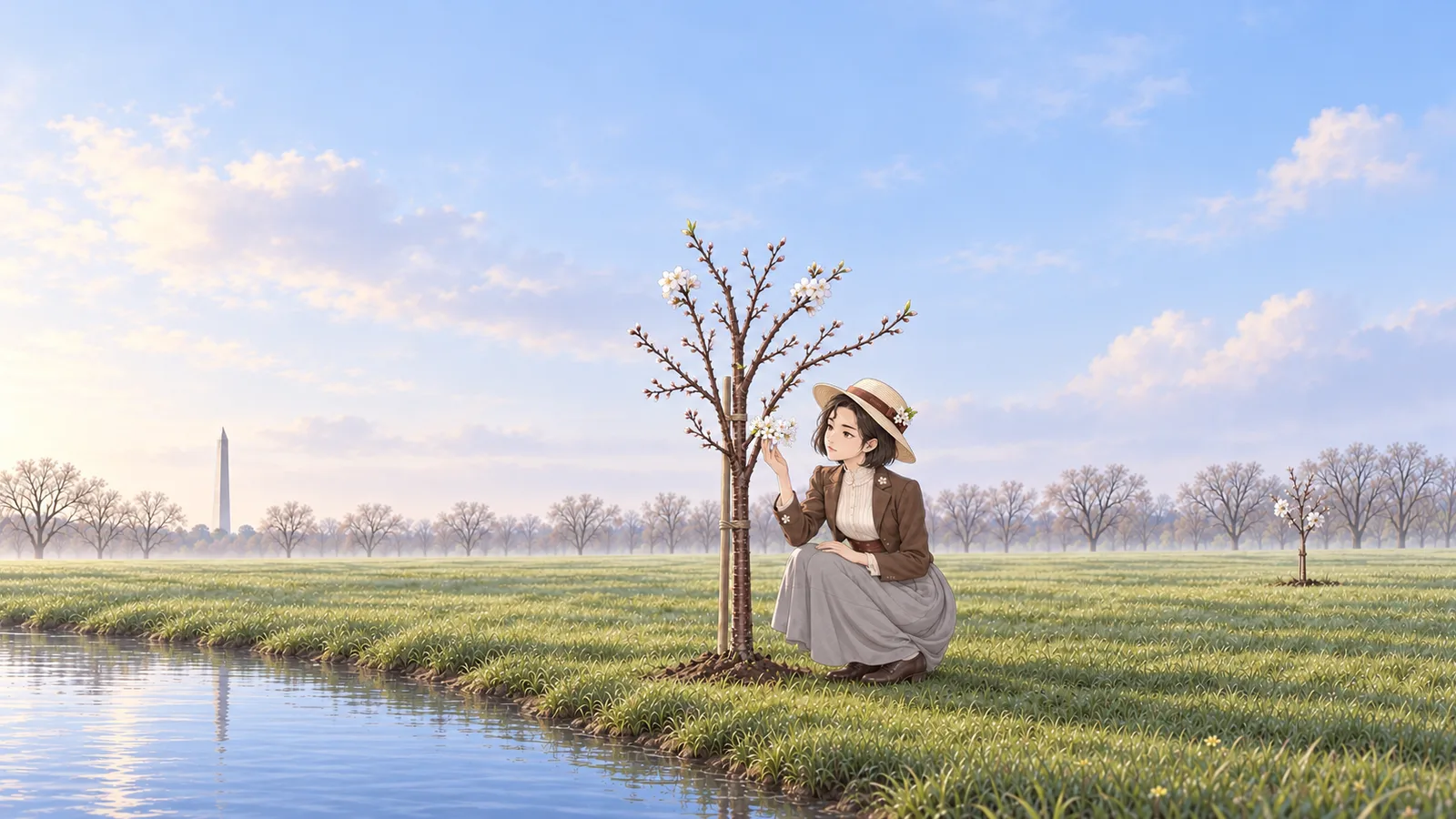
According to the U.S. National Park Service (NPS) timeline, the author and traveler Eliza Scidmore proposed after her first visit to Japan in 1885 that Japanese cherry trees be planted along the Potomac, but it was not accepted, and over the next 24 years she made the same proposal to every new official in charge. In 1909 she wrote to First Lady Helen Taft with a plan to raise money and donate cherry trees, and Taft, who had lived in Japan, replied two days later that trees had been promised. The next day the Japanese chemist Jokichi Takamine offered to donate 2,000 more trees, to be sent in the name of the City of Tokyo with the support of Mayor Yukio Ozaki. The 2,000 trees that arrived in January 1910 were found to carry pests, nematodes and disease, and President Taft agreed to burn them to protect American growers. The Japanese side took this with resolve and goodwill, and sent again 3,020 trees grafted onto rootstock in Itami with scions taken from cherry trees along the Arakawa River. Of the 3,020 trees that arrived on 26 March 1912, 1,800 were Somei-Yoshino, and on 27 March Helen Taft and Viscountess Chinda planted two trees on the north bank of the Tidal Basin. After the ceremony the First Lady handed Viscountess Chinda a bouquet of "American Beauty" roses; the NPS says the National Cherry Blossom Festival grew out of this modest ceremony watched by only a few people, and that those two trees still stand, with a large bronze plaque near their base. In 1915 former President Taft sent flowering dogwoods in return, and the first cherry blossom festival was held in 1935. In 1952, when Japan asked for help restoring the grove of cherry trees along the Arakawa River, which had declined during World War II, the NPS sent budwood from descendant trees to Tokyo; after a flood in 1982 about 800 cuttings went to help restore a Yoshino grove in Japan, and in 2011 about 120 propagates from living 1912 trees went to Japan. In 2018 the Korea National Arboretum announced that the Jeju native Prunus yedoensis is a plant clearly distinct from the Japanese yedoensis cherries in Tokyo and Washington (Kyunghyang Shinmun report).
Sources — 12 records and legends
Records are facts written in the sources. Legends are stories handed down over time. Sources are in Korean.
Record
- The U.S. National Park Service records that of the 3,020 cherry trees donated by the City of Tokyo to Washington in 1912, 1,800 were Somei-Yoshino, and that on 27 March 1912 Helen Taft and Viscountess Chinda planted the first two trees.
미국 국립공원관리청 — History of the Cherry Trees · checked 2026-10-05
- The NPS introduces Eliza Scidmore as a traveler, author and diplomat, and records that after returning from her first visit to Japan she proposed to the official in charge of public buildings and grounds that Japanese cherry trees be planted on the reclaimed land along the Potomac, and that she made the same proposal to each new official for the next 24 years.
미국 국립공원관리청(NPS) — History of the Cherry Trees · checked 2026-10-04
- The NPS records that 2,000 cherry trees from Japan arrived in Washington on 6 January 1910, that a Department of Agriculture inspection team found pest and nematode infestation and disease, and that on 28 January President Taft agreed to burn them.
미국 국립공원관리청(NPS) — History of the Cherry Trees · checked 2026-10-04
- The NPS records that on 27 March 1912 Helen Taft and Viscountess Chinda planted two Yoshino cherry trees on the north bank of the Tidal Basin, that in 1915 former President Taft sent flowering dogwoods to Japan in thanks, and that a first "cherry blossom festival", co-hosted by citizens' groups, was held and has been held every year since.
미국 국립공원관리청(NPS) — History of the Cherry Trees · checked 2026-10-04
- The Kyunghyang Shinmun reports that on 13 September 2018 the Korea National Arboretum announced the decoding of the whole genome of the Jeju native Prunus yedoensis, that the Jeju plant was confirmed to be clearly distinct from the Japanese yedoensis cherries planted in Tokyo and Washington, and that the Jeju yedoensis is a first-generation natural hybrid of Prunus pendula f. ascendens (maternal) with Prunus serrulata or Prunus sargentii (paternal), while the Japanese one is an artificial hybrid of Prunus pendula f. ascendens (maternal) and Prunus speciosa (paternal).
경향신문 '"제주 왕벚나무, 일본 왕벚나무와 뚜렷이 구분"…유전체 첫 해독' (2018-09-13, 이종섭 기자) · checked 2026-10-04
- The NPS writes that Scidmore's first proposal in 1885 "fell on deaf ears".
미국 국립공원관리청(NPS) — History of the Cherry Trees · checked 2026-10-05
- The NPS records that in 1909 Scidmore wrote to the new First Lady, Helen Taft, with a plan to raise money to buy cherry trees and donate them to the city, and that Taft, who had lived in Japan and knew its cherry blossoms, replied two days later, "Thank you for the suggestion; I have taken this up and secured the trees."
미국 국립공원관리청(NPS) — History of the Cherry Trees · checked 2026-10-05
- The NPS records that the day after Taft's letter, the Japanese chemist Jokichi Takamine (discoverer of adrenaline and Taka-diastase), who was in Washington, offered to donate 2,000 more trees; the Japanese consul in New York, Mizuno, suggested sending them in the name of the City of Tokyo, and Tokyo Mayor Yukio Ozaki supported this.
미국 국립공원관리청(NPS) — History of the Cherry Trees · checked 2026-10-05
- The NPS writes that the Department of Agriculture concluded the trees must be destroyed to protect American growers, that the Secretary of State conveyed deep regret to the Japanese ambassador, and that the Japanese side took the news with resolve and goodwill. It records that Mayor Ozaki and others proposed a second donation, raising the total to 3,020 trees, and that the scions were taken in December 1910 from famous cherry trees along the Arakawa River in Adachi ward, Tokyo, and grafted onto specially selected rootstock in Itami, Hyogo Prefecture.
미국 국립공원관리청(NPS) — History of the Cherry Trees · checked 2026-10-05
- The NPS writes that after the ceremony on 27 March 1912 the First Lady handed Viscountess Chinda a bouquet of "American Beauty" roses, that the National Cherry Blossom Festival grew out of this modest ceremony watched by only a few people, and that the two trees planted that day still stand west of the John Paul Jones Memorial, with a large bronze plaque near their base. Yoshino cherry trees continued to be planted around the Tidal Basin from 1913 to 1920.
미국 국립공원관리청(NPS) — History of the Cherry Trees · checked 2026-10-05
- The NPS writes that the cherry-tree avenue along the Arakawa River in Tokyo, the parent of Washington's first cherry trees, declined during World War II, and when Japan asked for help restoring it, budwood taken from its descendant trees was sent to Tokyo, a cycle of giving and friendship that the cherry blossom symbolizes. In 1965 the Japanese government donated 3,800 Yoshino cherry trees again, to First Lady Lady Bird Johnson.
미국 국립공원관리청(NPS) — History of the Cherry Trees · checked 2026-10-05
- The NPS records that in 1982, when a change in a river's course in Japan flooded a bank of Yoshino cherry trees, Japanese horticulturists took about 800 cuttings from the Tidal Basin Yoshino trees to restore the grove; that on 27 March 1996 a sister-river agreement was signed between the Potomac and the Arakawa; and that in 2011 about 120 descendants of the 1912 trees were sent to the Japan Cherry Blossom Association to carry on the genetic line.
미국 국립공원관리청(NPS) — History of the Cherry Trees · checked 2026-10-05
Spot a mistake?Tell usRead in Korean